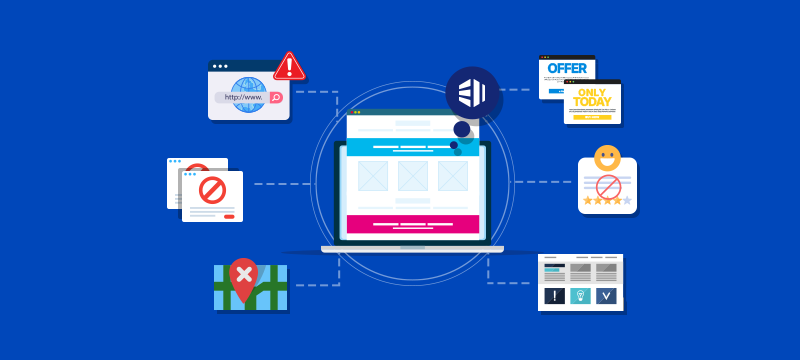
With today’s consumers becoming increasingly wary of online scams, websites that appear untrustworthy will often find visitors leaving within seconds of arrival. Whether it’s a missing SSL certificate, an outdated site design or vague contact information, these problems can result in high bounce rates and lost sales. In this post, we discuss six of the most common website trust issues that lead to site abandonment and explain what you can do to fix them.
Contents
1. Missing or invalid SSL certificate
Consumers need to be confident that the websites they visit are trustworthy. If they are suspicious that their data or money might be stolen, they will leave. A vital way to protect visitors is to install an SSL certificate. SSLs encrypt user data, including payment information, preventing theft or tampering as it’s transmitted from users’ browsers to your site.
Having an SSL certificate also means that web browsers, like Chrome, will label your site as secure in the address bar. Websites without an SSL, however, are labelled as ‘Not Secure.’ This is a red flag that warns visitors that using your site may be risky, causing many to leave.
How to fix it: Install an SSL certificate. Most web hosts, including eukhost, provide free SSL certificates through Let’s Encrypt or premium options for extended validation.
Sell online? Read: Why SSL Certificates are Vital for eCommerce Security
2. No clear contact information
As cybercriminals often create fake websites to defraud consumers, users want to know that the business behind your website is genuine. One way they check this is by looking for a physical address and contact information on your site. As the Which? website warns, legitimate companies always show how to get in touch and websites that don’t have a contact page could well be fraudulent.
How to fix it: To increase trust and prove your legitimacy, you should clearly display your company’s physical location, phone number and email address on a dedicated contact page. Many companies also include this information in the footer.
3. Outdated or broken design
Website design plays an important role in establishing user trust. A survey by Stanford University in the US showed that 46% of users assessed a website’s credibility based on its visual design. Prorealtech, meanwhile, noted that visitors take just 0.05 seconds to judge trustworthiness and that 94% of first impressions are related to design.
The link between design and trust is that users expect genuine businesses to keep their websites well-maintained. If the design looks outdated, has broken links or fails to load properly on mobile devices, users begin to question its legitimacy. Bad design can be a signal of a fake website hurriedly created by cybercriminals to scam people.
How to fix it: You can address this website trust issue by updating your design so that it meets today’s user expectations. It needs to look professional, be mobile-friendly, work on all browsers and load quickly. It also needs to be free of errors, particularly things like poor spelling and grammar that are often signals of a fake site.
Find out more about the importance of loading times and how to improve them. Read: Why Website Speed is Still Vital in 2025
4. Poor security signals
Beyond SSL certificates, a lack of security signals can be a another website trust issue for visitors. The display of authorised payment gateway logos (e.g. PayPal or Stripe) is a sign that your company has legitimate relationships with these companies. If you don’t have them, users may be unsure whether you offer secure payment options.
Similarly, if you don’t have a privacy policy or a cookie consent banner, users may worry about how your site will handle their information.
How to fix it: Add trust badges from your payment processors and make sure you have a privacy policy page and cookie consent banner. Additionally, if your business has other accreditations or is a member of a chartered institute or other reputable organisation, display those banners too.
5. Overuse of ads, pop-ups or spammy elements
While a common feature of modern newspaper websites, aggressive pop-ups, auto-playing videos or banner ads can make a site feel untrustworthy and spam-ridden. These elements distract users from reading your content (sometimes taking over the whole screen on smartphones) and make your business look desperate for ad-click revenue.
As they do not give an impression of a professional business wanting to provide a good user experience, users associate these features with scams and low-quality sites. This erodes trust and increases abandonment.
How to fix it: If you do have pop-ups, use them sparingly and ensure they are non-intrusive, especially on mobile devices. Also, reduce the number of third-party ads and don’t allow videos to play automatically.
6. No social proof
According to Gartner, 90% of consumers search for social proof before making a purchase. This includes seeking information about the company and its products or services.
Social proof is particularly important if a user is unfamiliar with your company. Often wary of the self-promotion found on business websites, users will seek the opinions of others, both trusted reviewers and genuine customers, to get a clearer picture. If your website doesn’t display social proof, visitors may be unconvinced that your sales material is trustworthy or even doubt your business’s credibility.
How to fix it: Firstly, enable customers to leave genuine reviews and display testimonials from satisfied customers, ideally with names, company details or images. You can also create case studies, which are particularly useful for B2B companies.
Additionally, provide opportunities for independent reviews and ratings on other websites, e.g., Facebook, Google and Trustpilot and then link to them on your website.
Need more details? Read: 6 Social Proof Tips for Boosting Online Sales
7. Conclusion
Fearful of online scams, today’s visitors make snap decisions about websites based on the trust signals they find. If your site feels unsafe, incomplete or outdated, they’ll quickly leave and take their custom elsewhere. However, by addressing the website trust issues mentioned above, you can improve confidence in your site, reduce bounce rates and increase sales and conversions.
Looking to increase confidence in your website? With guaranteed uptimes of 99.9% and over, high-performance infrastructure and rock-solid security, including SSLs, our hosting lays the foundations that trustworthy websites need. For more information about our managed hosting solutions, visit our homepage.