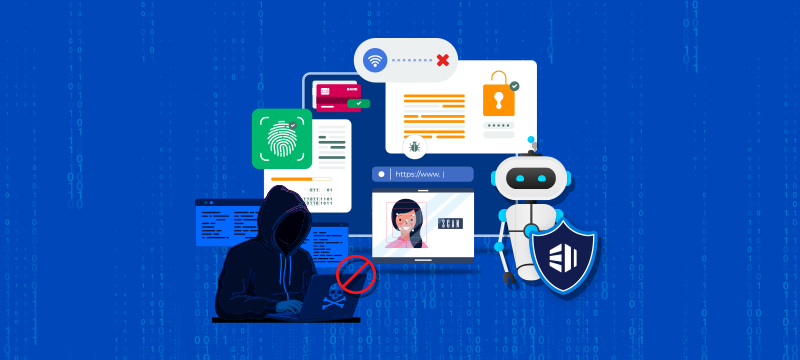
Experts predict that in 2026, cybercriminals will make greater use of emerging technologies, like AI. As a result, cyberattacks will be more autonomous, realistic and persistent, and smaller firms will be just as at risk as large enterprises. In this post, we look at the top cybersecurity threats for 2026 and explain how to protect your business from them.
Contents
Autonomous AI attacks
The evolving development of agentic AI, which can make decisions and undertake actions with limited human input, will enable criminals to carry out attacks autonomously. These tools not only scan the internet, looking for vulnerabilities in business systems, they also launch attacks and send phishing emails.
What makes them even more of a threat is that they learn from mistakes and can adapt if they have been blocked. Moreover, being automated, they can carry out attacks continuously. To combat this type of threat, businesses will need security tools that provide continuous automated detection and response, rather than relying on scheduled scans or manual checks.
Discover the benefits of Imunify360, read: The Hidden Cost of Not Using Imunify360: Real Risks for Unprotected Sites
AI-powered social engineering
The growing use of AI to copy companies’ tones of voice, mimic writing styles and even include real staff names scraped from the internet means phishing emails will be more difficult to spot. Indeed, some criminal outfits even use AI to build detailed employee profiles to make messages sound more convincing.
Furthermore, instead of relying purely on email, phishing messages are now being delivered via messaging apps and live chat, enabling them to evade the spam filtering tools that protect emails.
Deepfake voice and video impersonation
Given access to photos, videos or human voice recordings, AI can convincingly clone a manager’s voice or create a fake video call. Cybercriminals then use these to authorise unsuspecting employees to make payments or hand over login credentials.
By the end of 2026, deepfake impersonation is expected to be one of the fastest-growing threats, particularly for finance teams and IT admins.
Fake support and chatbot scams
One of the newest threats is that fraudsters are now deploying their own AI chatbots. These imitate company support systems so that customers believe they are talking to a genuine helpdesk when, in reality, they are being conned into handing over credentials or downloading malware.
In 2026, these attacks are expected to spread rapidly via search ads, social media and messaging platforms.
Data poisoning and AI manipulation
AI manipulation is a sophisticated form of attack which targets businesses that use AI to process data or run security tools. Attackers are able to manipulate these AI systems by feeding corrupted or ‘poisoned’ data into training sets to modify their behaviour.
For instance, by retraining a spam filter to ignore malicious emails or making a threat detection tool overlook specific patterns, it enables cyberattacks to avoid detection.
Cloud configuration errors
With so many businesses now storing data and running apps in the cloud, simple configuration mistakes are becoming a major cause of data leaks. For example, if file storage is set to ‘public’ instead of ‘private,’ or if staff permissions are too broad, confidential data can easily be exposed.
In 2026, cybercriminals will make increasing use of automated tools to search for these mistakes, so even a small oversight can quickly be found and exploited.
Identity and credential theft
The latest AI hacking tools can now test thousands of password combinations per second to attempt brute force attacks. Moreover, they use stolen credentials that are sold on the dark web and use AI to help them make more informed guesses.
Is your GDPR compliance under threat from overseas hosting? Read: Why UK Businesses Are Moving Back to Local Hosting Providers
How to protect your business
To deal with these threats in 2026, businesses will need layered defences that combine hosting-level protection, intelligent tools and staff training. Here are the key areas to focus on.
- Use managed hosting with built-in protection
Choosing a managed hosting plan provides businesses with proactive security features, such as malware scanning, DDoS protection, SSL encryption, spam filtering and automated backups. In addition, many providers will also offer a range of other security tools, such as Imunify360, Mimecast and email SSLs.Providers also apply patches automatically and remove detected threats without manual intervention, ensuring security is maintained around the clock.
Discover the other benefits of a managed solution. Read: Managed Web Hosting: Boost Productivity and Free Up Time
- Deploy intelligent firewalls
Firewalls protect against attacks by blocking suspicious traffic from reaching your server or applications. Web application firewalls (WAFs) protect websites against threats such as malicious bots, SQL injection and cross-site scripting, while network firewalls provide enterprise-grade protection for business systems, monitoring all incoming and outgoing traffic and detecting potential intrusions automatically.If you have a managed hosting plan, you may find that either a WAF or a network firewall is included.
- Strengthen email and messaging security
With phishing being the most common entry point for data breaches, having an advanced spam filter is essential. Today’s AI-powered filters can now analyse message content, sender behaviour and embedded links to detect the sophisticated AI-generated phishing attempts mentioned above.While live chat tools and messaging apps should have built-in phishing security from their vendors, businesses should protect their own web forms using CAPTCHA or reCAPTCHA to verify human users and honeypot fields to catch bots. In addition, they should use email validation APIs and server-side input checks to block malicious code.
- Adopt AI-enabled cybersecurity tools
Security platforms are increasingly using AI and machine learning to detect anomalies across networks and servers. These tools can identify emerging patterns in real time and automatically isolate suspicious activity before any damage takes place.Many managed hosting providers now integrate these proactive tools into their security setups.
- Enforce multi-factor authentication (MFA)
MFA adds a second layer of protection against unauthorised logins by requiring additional verification besides username and password. To protect against brute force attacks and the use of stolen login credentials, it should be used on all hosting accounts, CMS dashboards, cloud services and email platforms. - Keep everything updated
Outdated software continues to be one of the biggest vulnerabilities for businesses. To protect against this, enable automatic updates for your CMS, plugins, applications and operating systems, and remove unused plugins that could be exploited.Managed service providers carry out operating system patching and updates on your behalf.
- Build awareness and readiness
While new technologies are helping to stop attacks, it’s equally important to provide regular staff training on identifying phishing and social engineering scams, like fake helpdesk chats and deepfake calls.It’s also vital to develop a security-first culture where unusual activity is immediately reported, and there is an incident response plan in place.
Key takeaways
- Autonomous AI systems will enable cybercriminals to run continuous, self-learning attacks.
- Deepfake voices and videos will make impersonation harder to spot.
- Fake chatbots will target customer support and brand trust.
- Cloud misconfigurations will continue to expose sensitive data.
- Managed hosting, firewalls, spam filters and AI-based protection form the basis of strong security.
- MFA, regular updates and staff awareness are vital for ongoing protection.
Conclusion
In 2026, cyberattacks will be smarter, faster and more convincing. However, by opting for secure, managed hosting, implementing layered protections and regularly training staff, businesses can stay one step ahead of evolving threats. Moreover, with cybercriminals adopting AI and automation to launch attacks, businesses should use the same tools to automate and strengthen their security.
A HM Government G-Cloud provider with Cyber Essentials Plus accreditation and ISO 27001 certified data centres, eukhost puts security at the heart of our operations. For information about our wide range of managed hosting solutions and the robust defences we use to protect them, visit our homepage.