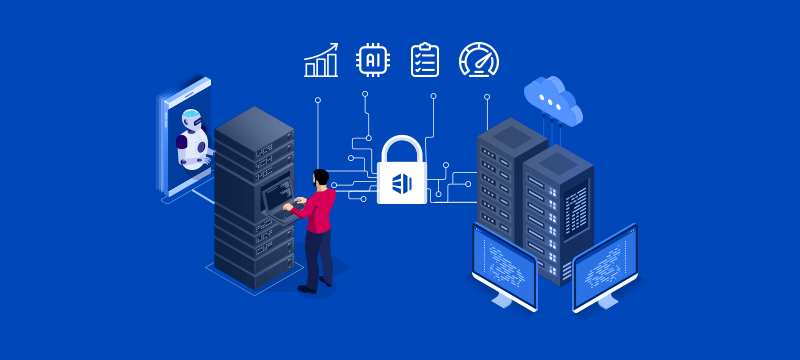
The promise of speed, flexibility, reduced capital expenditure and freedom from hardware management has led many businesses to adopt cloud-only environments. Today, however, the need for better performance, security and cost control means that not all workloads are best suited to the public cloud. In this post, we examine why businesses are increasingly turning to dedicated and hybrid servers instead.
Contents
A workload-first approach
In the past, businesses adopted the cloud rapidly, often to enable faster deployment, improve scalability and reduce infrastructure investment. In many cases, this occurred without firms fully understanding how their systems would perform, scale or cost over time.
Today, they have a clearer insight into which environments best suit different workloads, and this has prompted them to reassess where they should be run.
As a result, businesses are beginning to integrate different environments, with infrastructure choices based on operational needs rather than convenience. Dedicated and hybrid servers are important options because they offer companies greater control over performance, cost and risk.
Keep up-to-date, read: The Future of Cloud and Hybrid Hosting: What to Expect in 2026
The case for dedicated servers
The rapid rise of cloud computing led some businesses to view dedicated servers as a legacy technology. In practice, however, they remain a sensible option for companies that require consistent performance, predictable costs and stronger security controls. They are also well-suited to AI training and inference workloads.
- Consistent performance for critical systems
While public cloud platforms are designed to scale for short-term spikes in demand, dedicated servers are more suited to workloads that run continuously and need predictable performance.Unlike multi-tenant public cloud environments, a dedicated server’s physical resources are exclusively reserved for a single tenant. This means that the workloads of other users have no impact, ensuring consistent performance for systems where delays cause problems.This makes dedicated servers a suitable option for applications that need fast and reliable response times, such as transactional platforms, customer-facing services and systems that support internal operations. Consistency is also beneficial for AI workloads that need steady access to processing power to ensure reliability and high-quality output. - More predictable costs
Unpredictable cloud costs have become a growing issue for businesses, with variable pricing making budgeting difficult, especially when workloads are stable, but resource usage is high.One benefit of dedicated servers is that their fixed monthly costs make forecasting and financial planning simpler. For instance, for businesses with long-running workloads, this often results in more predictable spending and fewer unexpected charges related to usage spikes, storage growth or data transfers - Simpler security and compliance management
For businesses in regulated sectors, security is harder to manage in multi-tenant public cloud environments because responsibility is split between the provider and the customer. Physically isolated dedicated servers, on the other hand, give teams full control over how their systems are secured and who can access them.This approach simplifies compliance and ensures sensitive data is kept on dedicated infrastructure, where storage location, access and protection are controlled by the businessFor more information, read: Why Dedicated Servers Are Still the Gold Standard for Data Security
- Supporting AI and high-performance workloads
AI and machine learning workloads usually require continuous processing power, significant amounts of memory and, in some cases, dedicated GPUs.While public cloud platforms offer AI services, they are not always the right choice for running training or inference workloads, as performance can vary and costs can rise with constant use. Dedicated servers offer greater efficiency as performance remains consistent and the costs are fixed rather than usage-based.
The case for hybrid infrastructure
Given the benefits of cloud and dedicated servers for specific workloads, for many businesses, the most suitable option is to create a hybrid environment that utilises both. Here, we explore the advantages of hybrid infrastructure.
- Flexibility without permanent overcapacity
For many businesses, demand is generally predictable most of the time, with occasional spikes caused by seasonal traffic or marketing campaigns. Using infrastructure that always has the capacity to handle peak demand often means paying for resources that, for most of the year, are not needed. This is now seen as an inefficient and unnecessarily costly approach.With a hybrid setup, dedicated servers of a fixed size and cost can be used to run critical systems, while public cloud resources can be temporarily added to handle spikes. This ensures that additional capacity is only used and paid for when needed, not all year round. - Running workloads where they work best
Rather than being limited to either a dedicated server or the cloud, a hybrid environment lets businesses develop an infrastructure that suits their operational needs. This gives them the flexibility to run workloads on the most appropriate infrastructure, depending on factors such as performance, cost or regulatory requirements. - Improved resilience and recovery planning
Ensuring resilience used to mean creating a backup data centre that mirrored the live environment. While effective, this approach was costly and, for many companies, difficult to justify for non-critical systems.Hybrid infrastructure enables a more practical and cost-effective alternative. By using the public cloud for backups, recovery and failover, geographic separation and continuity can be achieved without the need to maintain a second data centreThis setup also makes it easier to test and improve recovery plans, as backup and failover processes can be put in place without disrupting live systems. - Supporting staggered modernisation
Established businesses can find it challenging to move everything to new platforms in one go. A hybrid environment makes staged migration easier by allowing legacy systems to operate alongside newer applications and services.This approach reduces risk, minimises disruption and gives IT teams time to adapt processes, allowing modernisation to happen gradually rather than as a single, disruptive project.Is your cloud in the right country? Read: How UK Data Sovereignty Impacts Your Cloud Strategy in 2025
Key takeaways
- Businesses no longer treat the cloud as the default for every workload; they are choosing infrastructure based on how systems are actually used
- Dedicated servers are a good fit for workloads that need steady performance, predictable costs and full control
- Hybrid setups allow businesses to keep critical systems on dedicated servers, while using the cloud only where flexibility is genuinely needed
- AI and data-heavy workloads often run better on non-shared infrastructure that is designed for constant use
Conclusion
The growing use of dedicated and hybrid servers reflects a more pragmatic approach to infrastructure. Today, businesses are choosing environments based on how their systems actually run, using dedicated servers for stability, predictable costs and control, and the cloud for scalability, backup and recovery.
Considering a hybrid setup? Whether you need a dedicated server or cloud hosting, our managed solutions come with performance, reliability, security and 24/7 support as standard. For more information, visit our Dedicated Server and Cloud Server pages.