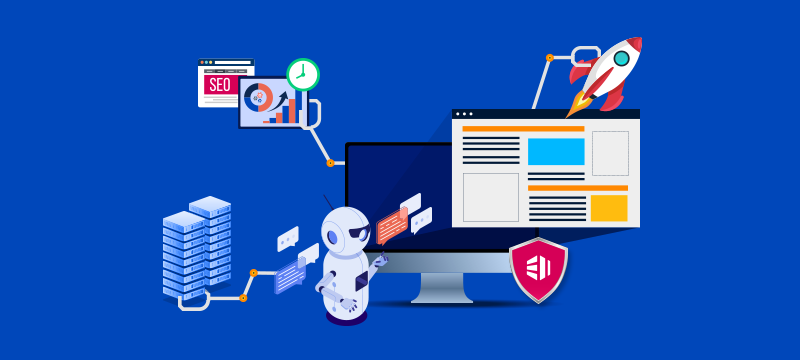
2026 is set to be the year that AI becomes integral to running a website. Rather than having standalone AI features, we’ll see co-pilots and other AI tools embedded into site builders, control panels, SEO tools, security platforms and more. In this post, we take a look at the AI tools that websites will be able to rely on this year.
Contents
AI website-creation tools
While website creation has become progressively easier over the years, AI is helping to make it even simpler and quicker. Rather than starting with a template and using drag and drop tools, AI-assisted platforms, like Sitejet, build the website for you in response to prompts and guided questions.
By providing information about your business name, branding, operations and goals, these tools use machine learning to build the site in a structured, step-by-step way. This often includes page layouts, navigation and industry-relevant starter content and imagery.
While these first AI drafts are unlikely to provide the exact final version of the website you want, it makes it much easier to customise the site to your exact needs. Whether it’s making global design changes, modifying single pages, adding new sections, or updating the text and images, there are built-in editing tools to help you hone the site before it goes live.
Is your site ready for the year ahead? Read: What Website Visitors Will Expect in 2026: Speed, AI and Trust
Control panel co-pilots
AI co-pilots are beginning to be built into control panels. These tools make it easier to manage your website and can assist with some technical admin tasks.
One key difference is that, rather than having to find and use specific tools within the control panel, you can instruct the co-pilot conversationally to carry out tasks like setting up a new email address or managing plugins. You can also ask questions, such as, why is the website running slowly.
Some co-pilots run in the background, monitoring site and server health. The tool then alerts you to issues or, in some cases, fixes them automatically. They also carry out automated updates. However, instead of applying updates directly to a live site, some co-pilots will first test the changes on a website copy to reduce the risk of conflicts or downtime.
Co-pilots are still evolving, and not all of them provide the same features. However, over time, they are likely to make site management much easier and less technically challenging.
AI-enhanced SEO tools
While tools to improve and simplify SEO have been around for a while, AI is turning them into automated SEO assistants.
Previously, these tools simply found SEO issues and suggested improvements. Now, AI-enhanced SEO tools, like Marketgoo, can implement some improvements automatically. For instance, they can generate and update page titles and meta descriptions with a single click, saving time and effort.
These tools also offer AI-enhanced keyword improvements. By analysing your pages, they can suggest relevant focus keywords and build them into your SEO.
Another important AI advancement is the ability to monitor your site’s SEO health. If the tool detects that your SEO score has dropped, it can send real-time alerts, together with context-aware advice for improvements, including suggestions for new content that is likely to perform well.
One final feature is enhanced competitor tracking. Rather than simply tracking competitor rankings, they can now analyse why your site is being outperformed and provide actionable steps to address this.
AI customer communication tools
During 2026, websites will increasingly rely on chatbots and AI-enabled email responders to handle routine customer enquiries. Able to answer common questions, such as opening hours, pricing, delivery details or account queries, either through on-site chat or automated emails, these tools can speed up responses and improve customer experience while reducing human input.
More advanced tools can also triage customer service queries: collecting basic information and passing the enquiry to the most appropriate personnel.
AI security tools
AI is starting to play a critical role in both website and email security. Website security tools analyse behaviour patterns to identify and block malware, intrusion attempts and suspicious activity that traditional rule-based tools can miss.
AI-enabled email security tools analyse message content, sender behaviour and reputation to filter spam, phishing attempts and malicious attachments. In addition, tools such as Imunify360 and SpamExperts use AI and machine learning to adapt to new threats as they emerge.
Discover more about Imunify360, read: The Hidden Cost of Not Using Imunify360: Real Risks for Unprotected Sites
AI tools used by hosting providers
Some of the AI tools that websites rely on will be deployed and managed by hosting providers, not website owners. Aside from advanced security tools, they also include those which monitor and manage infrastructure.
Able to track server health and performance, resource usage and traffic patterns, these tools identify issues, enabling providers to act before they affect websites. In some cases, the tools can work autonomously, reallocating resources or addressing problems in real time.
Where these tools are deployed, website owners can benefit from more reliable performance and improved uptime.
Keep up-to-date with hosting, read: The Biggest Web Hosting Breakthroughs You’ll See in 2026
Key takeaways
- In 2026, AI will be built into website and hosting platforms, not added as standalone features.
- AI website-creation tools are making it faster and easier to get a site live and customise it later.
- Control panels are beginning to use AI co-pilots to simplify site and server management.
- AI-enhanced SEO and customer communication tools help reduce manual work and prioritise actions.
- Many AI tools operate behind the scenes at the hosting level, improving security, stability and uptime.
Conclusion
Instead of standalone AI tools, in 2026, we will see a growing reliance on platforms that have AI built in. From website builders, control panels and SEO tools to customer communication systems and security platforms, AI will help website owners to build, run, manage and maintain their websites more effectively and with less effort.
Looking for a web host that integrates AI into its solutions and offers the latest AI-enabled tools? For more information about our full range of advanced hosting plans, visit our homepage.