The launch of AI Overviews has changed how search works. Rather than simply offering users a list of relevant websites, Google now also provides direct answers at the top of results pages. In this post, we explore Google’s own guidance and provide practical strategies to help you optimise your how-to blog posts for inclusion in AI Overviews.
Contents
What are Google AI Overviews?
AI Overviews are AI-generated answers that appear at the top of Google’s search results. They are created by summarising information from various websites, which are then cited and linked to in the Overview. While AI answers mean an increase in zero-click searches, citation provides increased visibility and makes a clickthrough more likely.
For more information, read: How Zero Click Searches Impact Website Visibility, Traffic & SEO
Why how-to content matters for AI Overviews
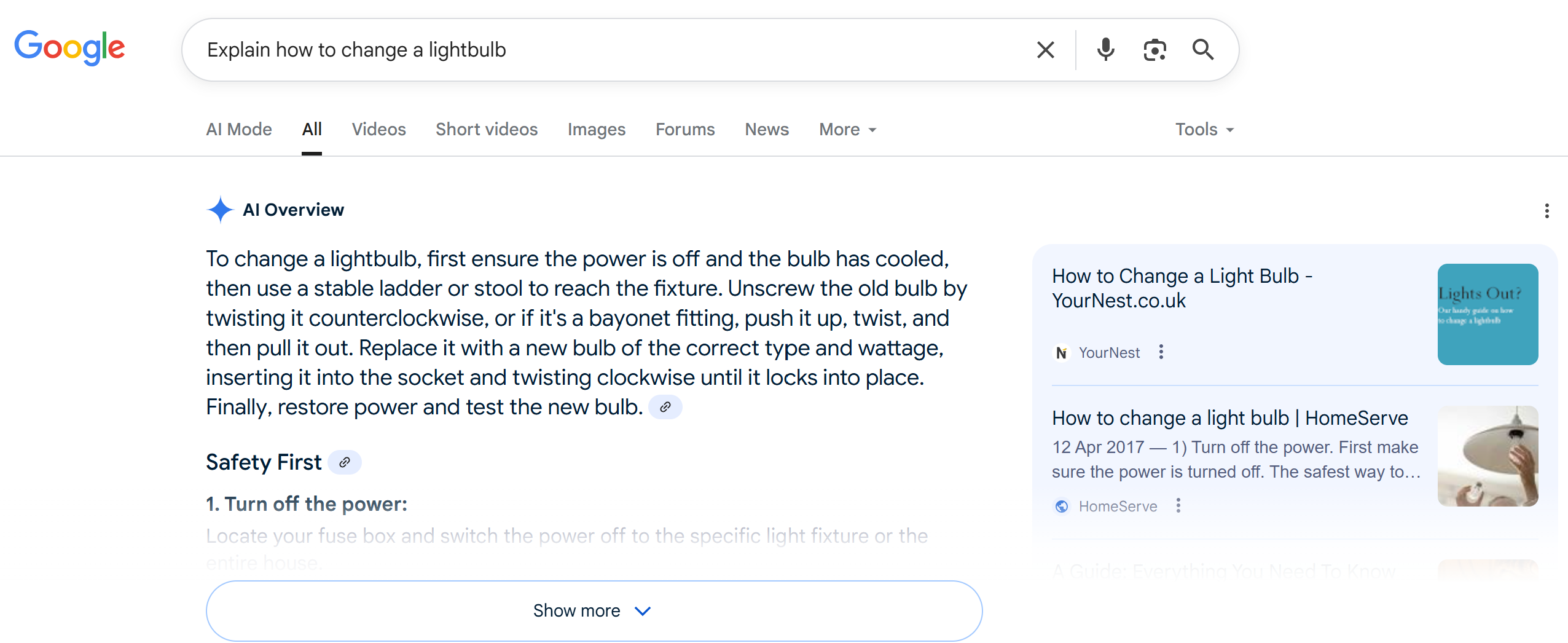
As AI Overviews are designed to answer how-to questions, creating how-to articles can be a useful way to get your content cited. Google’s John Mueller advises website owners to focus on creating unique content that actually helps people rather than trying to produce what they think Google’s algorithms want.
This means creating detailed, informative and well-structured guides that answer users’ specific queries and potential follow-up questions. Mueller suggests that although sites will receive fewer clicks, those cited in AI Overviews will receive visitors who are more engaged and more likely to convert.
Discover how search is evolving. Read: Why AI Algorithms Now Rule the Search Game
Structuring step-by-step guides
When selecting content for an AI Overview, Google prioritises both clarity and structure. For content creators, this means formatting your how-to articles in a way that is easy for both readers and computers to parse. For instance:
- Break down tasks into numbered steps, using H2 or H3 headings.
- Provide a summary of the main answer or method early in the piece.
- Keep sentences and paragraphs short and succinct.
- Where required, add visuals to support the instructions.
Using schema markup and FAQs
Using structured data improves Google’s ability to understand your content. When publishing how-to guides, the most useful formats are the HowTo schema for step-by-step articles and the FAQ schema for supporting questions.
John Mueller emphasises the importance of validating your schema with Google’s testing tools to ensure the structured data matches what is visible on the page. If not, he warns that Google may ignore it.
The value of FAQ sections, meanwhile, is that besides allowing you to provide answers to related queries on-site, they are also potential choices for Google’s People Also Ask boxes and AI Overviews, both of which prefer short, structured responses.
Writing with clarity, authority and conciseness
Google has consistently advised websites to create helpful, reliable, people-first content. To meet the standard for inclusion in AI Overviews, this means doing more than listing basic step-by-step guides.
In addition, you should provide unique insights, real-world examples and alternative approaches, as well as supporting data or references where relevant. Posts should also be accurate, up to date and include the author’s name and a short bio.
As AI Overviews are essentially summaries, Google’s algorithms prefer to cite content that is concisely written, with clear two or three paragraph answers and short ‘Key Takeaways’ sections providing Google with ready-made snippets that it can easily include.
One way to demonstrate subject authority is to create content clusters by interlinking related how-to posts. This will help Google identify your site as one that provides a comprehensive resource in your field of expertise.
Updating older content
Research from SE Ranking has shown that the majority of articles cited in AI Overviews were less than two years old. For websites whose blogs feature older posts, it is important that these are updated to ensure they remain relevant.
While this doesn’t mean rewriting everything from scratch, statistics must be up-to-date, the steps and advice provided must reflect current best practice, and screenshots should match modern interfaces. Crucially, the publication date should also be updated to signal freshness to Google and users alike.
Technical and hosting considerations
Other areas of importance for Mueller were ensuring your site provides a great page experience and that Google can access your content. This means:
- Making sure Googlebot is not blocked, and your pages return valid status codes
- Using responsive design so content displays well across devices
- Delivering fast load times and good Core Web Vitals (CWV) scores.
Core Web Vitals, which measure how quickly your pages load and respond, are key ranking criteria that can affect online visibility and the likelihood of appearing in AI Overviews. Hosting plays a vital role here, with high-performance infrastructure, such as SSD or NVMe storage and Intel Xeon processors, helping to reduce latency and improve CWV scores.
Learn more. Find out How Hosting Choice Affects Website Performance and Core Web Vitals
Conclusion
Appearing in AI Overviews will become increasingly important for websites as clickthroughs from traditional searches decline. According to Google, content should be of value, unique and be written for people, not algorithms. When optimising how-to blog posts, the focus should be on content relevance, conciseness and structure.
Key takeaways
- Provide unique, helpful and people-first content, as recommended by Google’s John Mueller
- Structure guides with numbered steps, concise answers and scannable formatting
- Use HowTo and FAQ schema, ensuring markup matches visible content
- Keep posts fresh with regular updates and build topic clusters for authority
- Support optimisation with fast, reliable and mobile-friendly hosting
Whether you need shared hosting, VPS, cloud or a dedicated server, our state-of-the-art infrastructure is built to deliver the reliability and performance that boost page experience and increase your content’s chances of being cited in AI Overviews. For more information about our range of hosting solutions, visit our homepage.