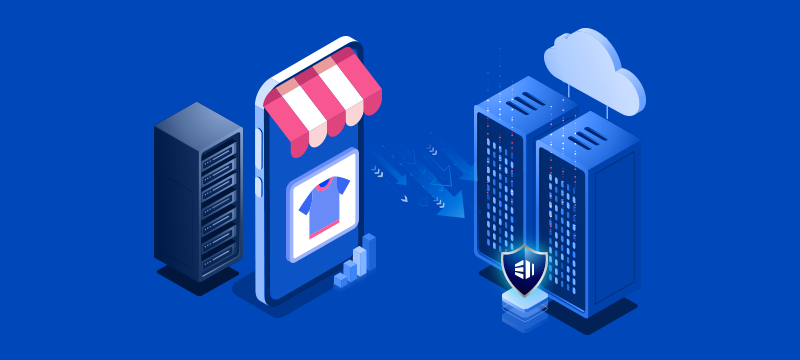
It’s a common assumption that as an online store grows, cloud hosting is the natural next step. Growth alone, however, isn’t a reason to migrate. A well-resourced VPS can run an e-commerce store perfectly well for a long time. The time to consider e-commerce cloud hosting is when the current setup regularly comes under pressure, traffic is difficult to predict, or the business needs more flexibility and resilience. In this post, we look at the signs that a move may be the right decision and when staying with VPS still makes more sense.
Contents
Why e-commerce businesses often start with VPS
An e-commerce VPS offers growing online stores a significant upgrade from shared hosting. Providing greater control over the hosting environment and more computing resources, including allocated CPU, RAM and storage, it enables stores to run larger databases and handle more traffic and transactions.
In addition, if more capacity is needed, businesses can often move to a larger VPS plan without the technical challenges of changing platforms. A VPS also offers greater cost certainty, as it provides a defined level of resources for a predictable monthly cost.
Managed VPS hosting, where the service provider handles areas of server administration, can also reduce the burden on the business, freeing up IT teams. Depending on the provider and plan, this may include operating system maintenance, security patching, monitoring and technical support.
For more information, read: How VPS Hosting Improves Website Stability During Traffic Spikes
Signs your current VPS may be under pressure
The signs that a VPS no longer meets an online store’s needs usually appear at the busiest times. For instance, a site that normally runs well might noticeably slow down when an email campaign goes out, a sale starts, or seasonal demand brings more customers on-site at once.
Signs that the VPS is reaching its CPU or RAM limits can include product pages becoming sluggish under load, site searches taking longer, delays at checkout or the database struggling when more customers place orders at the same time.
Resources can also become stretched as the site develops. This can happen when businesses add features such as stock integrations, product recommendation tools, CRM connections and third-party services, like chatbots, all of which place extra demands on the available resources.
While these signs might indicate that the VPS is the problem, businesses should first check that other issues are not the cause. Poorly optimised code, heavy plugins, inefficient database queries or an external API can all cause similar symptoms. Addressing these may prevent an unnecessary migration.
What cloud hosting changes
A key difference with cloud hosting is that businesses have more flexibility to increase computing resources as their needs change. For instance, CPU, RAM and storage can be scaled on-demand when additional capacity is required.
This makes cloud particularly useful for stores where demand varies considerably. If they experience higher demand during Christmas or promotions, they can quickly increase resource capacity to handle it.
Cloud can also offer greater resilience than a VPS. Cloud servers run on clustered infrastructure, so if there is a problem with the physical hardware, the server can be moved to other hardware within the cluster. This can improve availability and reduce the impact of hardware failure.
Cloud infrastructure can also distribute workloads, such as the website and database, across separate resources. This helps prevent one busy workload from slowing the rest of the store, while allowing capacity to be added where needed. The trade-off is that the cloud can be more complex when it comes to infrastructure design and cost management.
For a broader look at the hosting needs of online stores, read: E-commerce Hosting Essentials for 2026
VPS vs e-commerce cloud hosting
The key consideration when comparing VPS vs cloud hosting is not which technology is better, but which environment best suits the way the store operates. The chart below highlights the main differences.
| Area | VPS hosting | Cloud hosting |
|---|---|---|
| Resources | Defined resources provide a predictable environment. | Resources can be scaled more flexibly as requirements change. |
| Traffic patterns | Well suited to stable or reasonably predictable demand. | Useful where demand changes significantly or peaks are harder to predict. |
| Scalability | Capacity can usually be increased by moving to a larger VPS plan. | Offers broader options for adding resources or distributing workloads. |
| Resilience | Depends on the VPS platform and wider hosting infrastructure. | Clustered infrastructure can provide greater resilience to hardware failure. |
| Complexity | Usually simpler to manage. | Can involve multiple servers, services and dependencies. |
| Cost control | More predictable costs with fixed resources. | Costs may require closer monitoring as resource use changes. |
| Management | Managed VPS can reduce routine server administration. | Managed cloud can reduce the burden of operating a more complex environment. |
| Business criticality | Can suit revenue-critical stores where demand is predictable and resilience needs are met. | Useful where critical workloads need greater resilience or flexibility. |
When considering scalable e-commerce hosting, this distinction matters. If a VPS still offers room to grow and demand is predictable, the cloud may add unnecessary complexity without solving a real problem. However, if capacity needs change frequently or the application needs a more flexible architecture, the cloud’s benefits become clearer.
When you should stay on VPS
Just because a store has grown doesn’t mean cloud migration will bring benefits. If traffic remains stable, the VPS has enough resources, the database performs well and busy periods don’t create issues, staying with a VPS may be the right choice. The same applies if the server can be upgraded easily as demand increases and there is no need for greater resilience.
A VPS can also be more suitable for businesses that prefer a simpler hosting environment and predictable costs. With a managed VPS, businesses can have the resources and technical support their store needs without the extra management complexity that cloud can introduce.
In short, if the existing VPS setup works well, e-commerce stores should have a clear business or technical reason to migrate.
Before migrating, assess these five things
The move to cloud hosting for e-commerce should be based on evidence. Before deciding, businesses should assess:
- Traffic pattern: Look at normal traffic, seasonal peaks, campaigns and the number of customers using the store at the same time.
- Application architecture: Assess the e-commerce platform, integrations, APIs and background processes to identify where resource demands are highest.
- Database behaviour: Check whether the database is responsible for slowdowns, particularly during searches, account activity and checkout.
- Backup and recovery requirements: Decide how much data the business can afford to lose and how quickly important services need to be restored.
- Migration and management responsibility: Establish who will design the environment, migrate the store, test it and manage it afterwards.
These checks can help show whether e-commerce cloud hosting will solve a specific problem and what the new environment actually needs to deliver.
Conclusion
The move from VPS to e-commerce cloud hosting should be to solve a defined operational problem, not simply a response to growth. If a VPS continues providing the capacity, performance and straightforward management the business requires, there might not be a genuine reason to migrate. What is important is identifying where the existing setup no longer delivers, so businesses can choose the infrastructure that best addresses their needs.
Need greater scalability, resilience and flexibility for your e-commerce store? Find out more about eukhost Managed Cloud Servers, or speak to the team about the right setup for your business